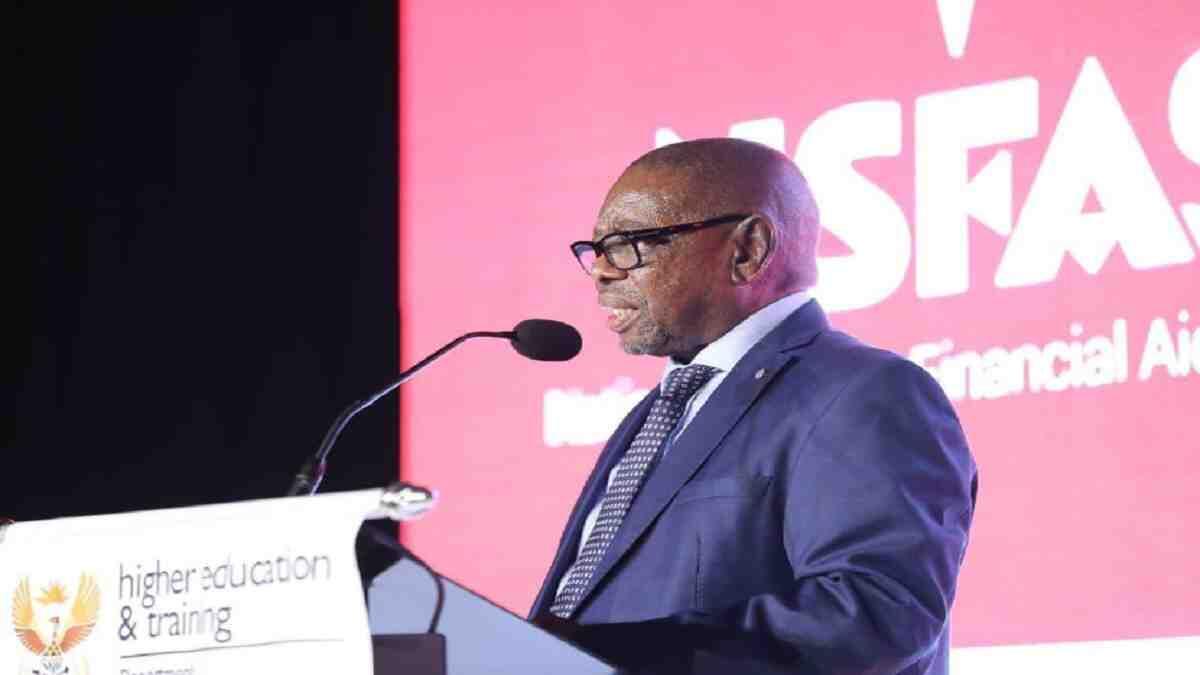
In May of this year, Minister of Higher Education, Blade Nzimande, tabled the Department of Higher Education and Trainings (DHET) budget vote in Parliament and announced an allocation (for the entire sector) of R133.8 billion for the 2023/24 financial year, with an annual average increase of 5.3%.
At its inception in 1991, the NSFAS bursary scheme has had a budget of R21.4 million allocated to the first cohort of about 7,000 students.
At the time, Nzimande noted:
We are proud to say that the National Student Financial Aid Scheme (NSFAS) is currently funding 1.1 million students with a budget allocation of R47,6 billion in the 2023 academic year.
Tertiary Education Funding In 2023
But, the year 2023 marks the first year that the South African government has given more money to the National Student Financial Aid Scheme (NSFAS) – an amount of R47 billion to undergraduate students – than to universities, according to Universities South Africa (USAf).
On the positive side, this could lead to greater opportunities for efficiency.
Dr. Marcia Socikwa, Deputy Director-General (DDG) at the Department of Higher Education and Training (DHET) had worked in the university sector, and knew where it could be “extremely inefficient” and where adjustments could be made, she said.
It means that universities need to start looking at third-stream income to beef up their coffers.
Dr. Socikwa was speaking at the Joint Colloquium on Multilingualism in the Teaching and Learning of Mathematics – Enhancing Success at Stellenbosch University (SU) on 17 August.
She made these comments during a panel discussion on Funding and collaboration between stakeholders and disciplines.
The other panelist was Mr. Lance Schultz, CEO of the Pan South African Language Board (PanSALB), a government organisation established to preserve, promote and protect the country’s languages and foster multilingualism.
Multilingualism In South African Education
Language serves as a foundation for education across all age groups of society. As a country composed of a multilingual society, the need for indigenous language-speaking learners to be accommodated in South African schools is still a legitimate concern for the Department of Basic Education.
One of the well-known facts about South Africa’s basic education system is that the majority of schools across the country teach all subjects in English from the foundation phase right through to the secondary phase of school.
However, children who speak African languages at home suffer greatly as a result of this, as many of them are not sufficiently capable of understanding the material that is being taught to them.
Fortunately for this cohort of school learners, an amendment to the Basic Education Law Bill aims to rectify this by adding indigenous African languages to the list of languages taught in schools after Grade 3.
Additionally, changes to the legislation aims to give the government authority over governing bodies, which now influence language rules in schools.
However, many opposed to multilingual education have expressed doubts about its viability and cost. A bilingual curriculum would need to be developed, and qualified instructors would need to be recruited.
The idea that creating multilingual learning environments is expensive has been refuted by Dr. Xolisa Guzula, UCT academic in Applied Language and Literacy Studies.
Guzula says the basis that multilingual writing is possible for materials and that in the Western Cape, the department and education specialists have been experimenting with a bilingual science curriculum.
This language barrier may continue into higher education, making studying a bit challenging for non-English speaking students.
Overseas Funders Are Willing To Invest In Multilingualism
Professor Mbulungeni Madiba, Dean of Education at Stellenbosch University said without the financial resources, universities were going to struggle.
With reference to an earlier mention by Dr Socikwa, of R70million funding allocated by the DHET for universities’ implementation of language plans in response to the Language Framework for Higher Education Institutions, Professor Madiba posed this question to the DDG: Your department allocated R70m that will be run by the University of the Western Cape (UWC). Can you comment a bit about that?”
Dr. Socikwa responded that the allocated budget was initially for 2024 to 2027. However, “if universities developed plans and the panel located in UWC feels they make sense, they will be allocated R2.5 million."
Our decision making is evidence-based. If your impact reports advocate or justify for additional funding, we are then able to lobby our international partners. The European Union has been fantastic in this regard. It’s almost a step-up process because no one’s going to give you money for nothing. The evidence-based, stepped-up process to secure additional funding for additional research is the route to go.
Another possibility was to partner with the Department of Science and Innovation (DSI) on Humanities-related projects.